
Camera Trapping Sensor Comparison
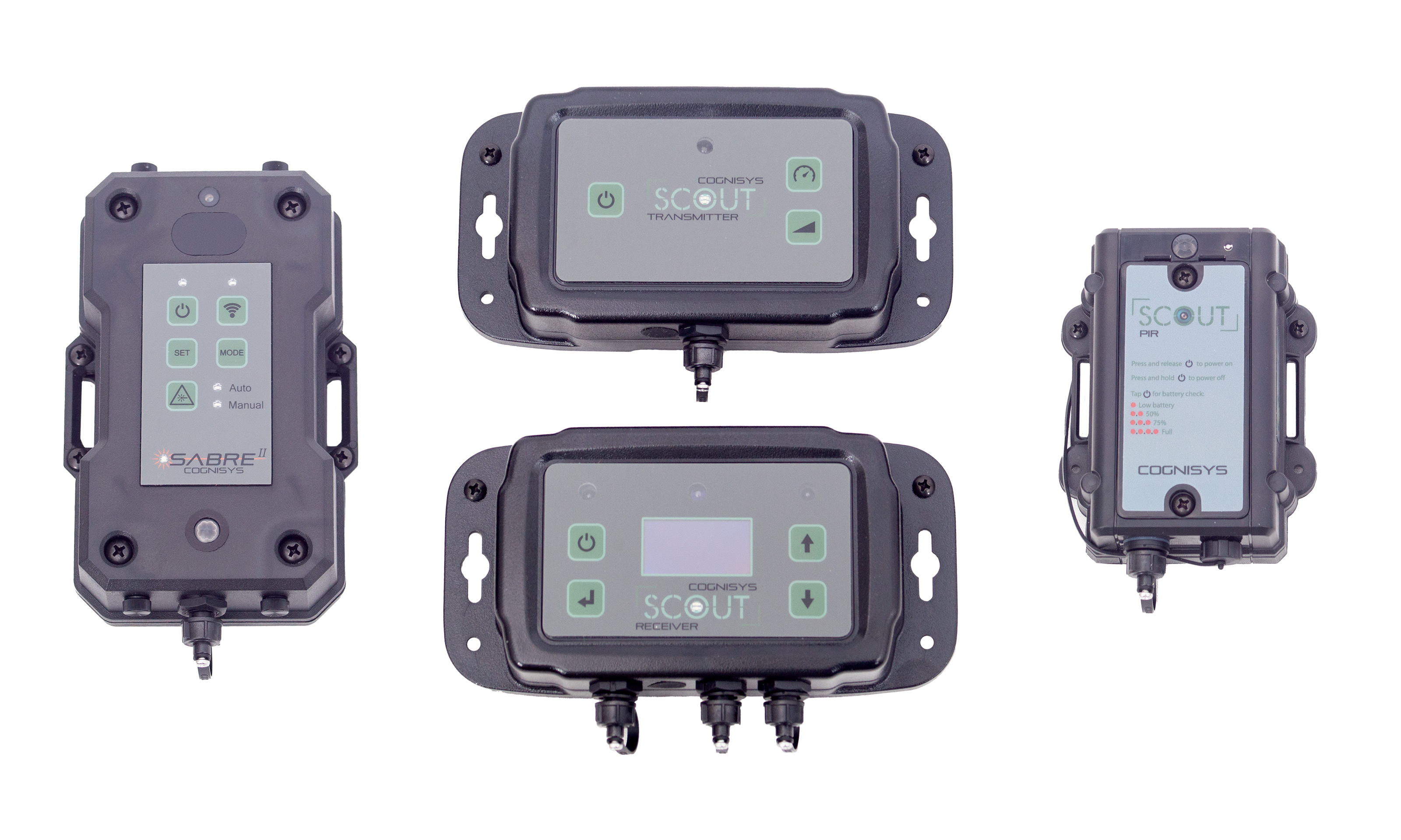
| Sabre II | Trail Monitor | PIR Sensor | |
| Size | 163 x 104 x 65 mm | 140 x 89 x 38 mm x 2 | 116 x 92 x 37 mm |
| Weight with Batteries | 700 g | 1025 g | 290 g |
| Cost | $499 | $439 | $319 |
| Response Time | 100 mS (low power) | 100 mS (default) | 100 mS |
| Sensor Technology | LIDAR with PIR wake | Modulated Beam | Passive Infrared (PIR) |
| Beam Width at 1m | 3.5 cm | NA | >17 cm |
| Beam Width at 4m | 28 cm | NA | >140 cm |
| Internal Power Source | 3250 mAhr Li-Ion Pack | 6 x AA Batteries x 2 | 2 x AA Batteries |
| Max Range | 8 m (low power) | 40 m between RX/TX | 5 m |
| Light Source | IR Laser | IR LED | NA |
| Battery Life | 150 days (PIR Wake-up) | 100 days | 90 days |
| Single Ended |  |
- | |
| 1/4-20 Tripod Mount | |
|
|
| Weather Proof | |
|
|
| External Power Input | |
|
- |
| Wi-Fi Connectivity | |
- | - |
| Compatible with Scout Camera Box | |
|
|
| Full Independent 1/2 Press Control | |
|
|
Notes on Choosing a Sensor
Choosing the correct sensor can be tricky. There are a lot of considerations: Battery Life, Accuracy, Ease of Setup, False Trigger Tolerance, etc. There however a few situations where the decision is clear and easy. For example if you are shooting stills and you want to pre-focus the camera on a line where the subject will be then the Scout Beam Sensor is the clear choice. Likewise if you are shooting video that monitors a well defined trail and your subject (and sensors) will be out of frame when the recording starts then the Scout PIR is the sensor of choice. Another clear choice would be if you need precision triggering for a smaller subject, then the Sabre II is the way to go (you will likely want to use LIDAR only mode for this type of application). Each sensor has an application it is best suited for - knowing your environment and understanding how you will set up your camera trap is critical for choosing the correct sensor.